
Population Thematic Portal: News
2012 EPI Ranks the Environmental Performance of 132 Countries
Date: January 26, 2012
![]()
Announced at the World Economic Forum held January 25–29 in Davos, Switzerland, the 2012 Environmental Performance Index (EPI) produced by CIESIN and Yale University’s Center for Environmental Law and Policy (YCELP), in collaboration with the World Economic Forum and the Joint Research Center in Ispra, Italy, identifies Switzerland as first in addressing pollution control and natural resource management challenges. Iraq is ranked last. The EPI has been produced every two years since 2006. The 2012 EPI ranks 132 countries, using 22 indicators in ten major policy categories including air and water pollution, climate change, biodiversity, and forest management.
For the first time a complementary index showing country improvement from 2000 to 2010, the Pilot Trend Environmental Performance Index (Trend EPI), was released. Latvia was ranked number one in the Trend EPI, with Russia in last place. The U.S., which is 49th in the EPI, was just 77th in the Trend EPI, implying few recent gains in addressing environmental issues.
Data sets making up the EPI were contributed from the International Energy Agency, remote sensing research groups at Battelle and University of Maryland, the UN Food and Agriculture Organization, and other entities. Lack of data in certain areas—in particular, waste management, toxic exposures, agricultural sustainability and water resources—continue to limit the ability of the EPI to contribute towards the understanding necessary to develop policies for safeguarding the environment.
Project to Integrate Global Census and Environmental Data Launched
Date: October 6, 2011
![]()
The logo for Terra Populus: A Global Population/ Environment Data Network (TerraPop), which will integrate population census data from the past two centuries with environmental data. The project is led by University of Minnesota’s Minnesota Population Center, with CIESIN as a key partner.
The National Science Foundation has made a major, $8 million, five-year award to a team led by the University of Minnesota’s Minnesota Population Center for a new project, Terra Populus: A Global Population / Environment Data Network (TerraPop). The goal of TerraPop is to integrate population census data from the past two centuries with global land cover, land use, and other environmental data, providing a unique data access and analysis system for improving understanding of the interactions between humans and the environment from local to global scales. CIESIN is a key partner in the project, contributing its expertise in integrating socioeconomic and environmental data. CIESIN director Robert Chen, associate research scientist Susana Adamo, and senior digital archivist Robert Downs participated in TerraPop’s kickoff meeting September 29-30 in Minneapolis.
As part of NSF’s Sustainable Digital Data Preservation and Access Network (DataNet), TerraPop will develop a sustainable digital archive for its data, accessible to researchers worldwide and building on the distributed capabilities of its partners. The Inter-University Consortium for Political and Social Research (ICPSR) at the University of Michigan is also a key contributor to the project. Other participants from the University of Minnesota include the Institute on the Environment, the University of Minnesota Library, and faculty from the College of Liberal Arts and College of Science and Engineering.
CIESIN Releases Major Spatial Population Data Collection
Date: September 30, 2011
![]()
Urbanization poses both challenges and opportunities for sustainable development and environmental management. Improved data on patterns of human settlement and trends in population can help researchers and policy makers better understand differences between urban and rural areas in terms of their impacts on the environment and vulnerability to environmental variability and change. The newly released Global Rural-Urban Mapping Project, Version 1 (GRUMPv1) data collection is a valuable resource both for researchers studying human-environment interactions and for applied users working to address critical environmental and societal issues.
Developed by the NASA Socioeconomic Data and Applications Center (SEDAC) operated by CIESIN, GRUMPv1 consists of eight global data sets: population count grids, population density grids, urban settlement points, urban-extents grids, land/geographic unit area grids, national boundaries, national identifier grids, and coastlines. All grids are provided at a resolution of 30 arc-seconds (~1km), with population estimates normalized to the years 2000, 1995, and 1990. All eight data sets are available for download as global products, and the first five data sets are also available as continental, regional, and national subsets.
The population density and population count grids build on SEDAC’s Gridded Population of the World, Version 3 data set (GPWv3), which does not distinguish between urban and rural areas. GRUMPv1 identifies urban areas based in part on observations of lights at night collected by a series of Department of Defense meteorological satellites over several decades. The night-light data were carefully processed by the U.S. National Geophysical Data Center (NGDC) in Boulder, Colorado. CIESIN then used these and other supplementary data to develop an urban-rural “mask,” or urban extents grid, which identifies those areas of the Earth’s land surface that appear to be urbanized. GRUMPv1 also includes a geo-referenced database of urban settlements with populations greater than 5,000 persons, which may be downloaded in both tabular and shapefile formats.
New IUSSP Panel to Examine the Role of Population Dynamics in Climate Change
Date: July 6, 2011The International Union for the Scientific Study of Population (IUSSP) has named CIESIN associate research scientist Susana Adamo to a new panel exploring the role of population dynamics in climate change. Adamo, a demographer originally from Argentina, will serve with population researchers Leiwen Jiang (China), Wolfgang Lutz (Austria), and panel chair Adrian Hayes (Australia). Through cross-disciplinary research, meetings, and other activities, the panel will aim to expand a network of population researchers working in the area of climate change, contribute to greater understanding of how population processes interact with climate change, and share findings with the research and policy making communities. In addition, panel members will examine conditions for such cross-disciplinary research and what this might mean for demographic training. The panel has been established through 2014.
Interactive 3-D Globe Visualizes the Distribution of Global Population
Date: May 16, 2011
![]()
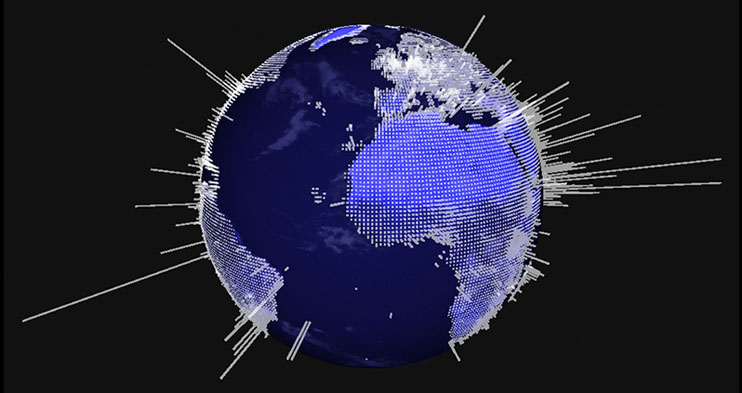
Screenshot of interactive 3-D World Population Globe showing year 2000 population distribution. CIESIN/Google.
Differences in population density around the world are dramatically illustrated in a new interactive 3-D globe developed by the Google Data Arts Team and available on Google's Chrome Experiment site. Based on the Gridded Population of the World version 3 (GPWv3) data set available from the NASA Socioeconomic Data and Applications Center at CIESIN, the World Population Globe illustrates population distribution and changes between 1990, 1995, and 2000 on a 1-degree latitude-longitude grid. The globe was developed using WebGL, the Web-based Graphics Library, which enables 3-D graphics without the use of a plug-in. Browsers that currently support WebGL include Google Chrome, Mozilla Firefox 4, and development releases of Safari and Opera. A compatible graphics card may also be needed.
World Population Figures May Top 10 Billion by the Year 2100
Date: May 7, 2011According to the 2010 Revision of World Population Prospects, the official United Nations population projections, the world population will reach 10.1 billion by the year 2100. These projections are prepared by the Population Division of the Department of Economic and Social Affairs. The biggest increase is projected for the so-called high-fertility countries, with 39 of this group in Africa, nine in Asia, six in Oceania, and four in Latin America. The United States is considered an intermediate-fertility country, and Canada is one of the low-fertility countries, as are many of the European countries
Among other findings of the report, life expectancy is projected to increase in all three groups of countries; and even small differences in fertility sustained over long periods will critically impact future population numbers.
New Report Marks Progress of Millennium Villages
Date: August 9, 2010
![]()
A new report highlights initial progress in achieving the Millennium Development Goals (MDGs) after three years of implementation across five of the initial Millennium Village sites. The report, Harvests of Development in Rural Africa, is based on results from the recently completed midterm surveys, focusing on sector-based gains (e.g., health, education, infrastructure, and gender) and site-specific gains in five out of twelve Millennium Village sites. These sites are located in Ghana, Kenya, Malawi, Nigeria, and Uganda.
The report compares data collected in the third year of the project to baseline measurements taken when the project was initiated. CIESIN, in collaboration with the Tropical Agriculture and Rural Environment Program of the Earth Institute (EI) and EI site teams, aided in the development and implementation of field and data management systems to collect, enter, clean, and analyze MDG-related survey data. The objective of these systems is to inform sustainable development activities over the 10-year time frame of the project and support research on how to transfer successful lessons to other areas.
The Millennium Villages pursue an integrated approach to sustainable development aimed at achieving all of the MDGs within African villages. The MDGs are an internationally agreed-upon set of specific goals based on numerical benchmarks, and include targets on income poverty, hunger, maternal and child mortality, disease, inadequate shelter, gender inequality, and environmental degradation.
Population Estimation Service and New Mapping Tools Added to GPW Web Site
Date: February 12, 2010The Web site for CIESIN’s flagship data product—Gridded Population of the World (GPW), now in its third version—has been enhanced with three new services and tools: the Population Estimation Service, a Web-based service for estimating population totals and related statistics within a user-defined region; and two mapping tools.
Because the Population Estimate Service is accessible through three standard protocols (the Open Geospatial Consortium (OGC) Web processing service (WPS) standard, a representational state transfer (REST) interface, and a simple object access protocol (SOAP) interface), it can accommodate a wide variety of map clients and tools and users can quickly obtain population estimates for specific areas without having to download and analyze large amounts of spatial data. Users submit polygons that define an area, then the service returns measures of population, land area, quality measures, and basic parametric statistics. These estimates are based on the gridded population data for 2005 from the GPW v3 data set developed by the NASA Socioeconomic Data and Applications Center (SEDAC) operated by CIESIN.
One of the new mapping tools also released, based on the technology used by Google Maps, demonstrates the Population Estimation Service. It lets users select an area of interest by drawing a polygon on the map and submit the request to the service, and it displays the results. The other tool is a basic mapper that provides previews of the GPW v3 data sets with an overlay of national boundaries, and lets users pan and zoom to an area of interest before downloading the data sets. For more complex visualization and overlay of other data sets, the stand-alone SEDAC Map Client is recommended.
Map Viewer Tutorial Now Available on YouTube Web Site
Date: January 8, 2010TerraViva! SEDAC Viewer is a map viewer and standalone software application that uses a powerful data-viewing engine and tools to enable the visualization and integration of hundreds of socioeconomic and environmental variables and layers, including a range of satellite-based data. A three-part tutorial that explains how to use TerraViva! is now available through the YouTube Web site. The tutorial was produced by senior research associate Alex de Sherbinin and senior media designer Al Pinto, under the auspices of the NASA Socioeconomic Data and Applications Center (SEDAC) operated by CIESIN.
New Grid-Based Cartograms Build on CIESIN Population Data
Date: October 4, 2009The Gridded Population of the World (GPW) version 3 data set available through the NASA Socioeconomic Data and Application Center operated by CIESIN is the basis for a new set of grid-based population cartograms for most countries of the world recently released on the interactive Worldmapper Web site. Worldmapper is a collection of cartograms in which a particular thematic variable is substituted for the land area of a map, effectively re-sizing the map. In the case of the population grids, each cartogram provides a distinctive visualization of the internal population variations within a country or region. More-populated areas appear inflated whereas less-populated areas are less prominent. The cartograms have been made available under the Creative Commons Attribution-Noncommercial-No Derivative Works 3.0 Unported license.
New Population Distribution Maps for Africa
Date: September 14, 2009Rapid global population growth is expected to be concentrated in low income countries, especially urban areas. Accurate measurement of the impacts of this growth is a critical foundation for monitoring changes and for planning interventions. The AfriPop project was initiated in July 2009 with an aim of producing a detailed and freely-available population distribution maps for the whole of Africa. Catherine Linard of Oxford University, U.K, and Andy Tatem from the Emerging Pathogen Institute and The University of Florida led the project. Spatially-linked census data for much of Africa was made available to the project by CIESIN.
Atlas of Livestock Production and Health Statistics Now Released
Date: June 25, 2009GLiPHA, the Global Livestock Production and Health Atlas, has been publically released. GLiPHA is an interactive, electronic atlas containing global animal production and health statistics. Sub-national statistics relating to the livestock sector can be viewed cartographically, against a back-drop of selected maps, such as livestock densities, land-use, and topography. Data may also be displayed and exported as tables and charts. The objectives of GLiPHA are to facilitate access to livestock sector information for analysis and informed decision making, and to increase awareness of sector-related social, health and environmental issues. GLiPHA draws on data managed within the Global Livestock Impact Mapping (GLIMS), a global, sub-national data warehouse containing a multitude of livestock-sector related information.
Key Inputs from SEDAC’s GPW Used in New EDGAR Release
Date: June 25, 2009SEDAC’s Gridded Population of the World (GPW) version 3 grids and population data are used as key inputs into the gridded products of version 4 of the Emissions Database for Global Atmospheric Research (EDGAR) released on May 25 by the European Commission’s Joint Research Centre (JRC) and the Netherlands Environmental Assessment Agency. In EDGAR v4.0, emissions for 1970-2005 are spatially allocated on detailed geospatial grids (0.1 degree) using the exact location of energy and manufacturing facilities, road networks, shipping routes, human and animal population density and agricultural land use. GPW version 3 grids were used to ensure consistency between the country totals and the gridded datasets. EDGAR v4.0 data are available for download at no charge at http://edgar.jrc.ec.europa.eu/.
New Report Says Climate Change May Cause Human Population Migrations
Date: June 10, 2009A new report says climate change may cause vast human migrations on an order not previously experienced. The report, In Search of Shelter: Mapping the Effects of Climate Change on Displacement and Migration, was written by researchers at CIESIN, the United Nations University, and CARE International. Drawing on empirical evidence from a new survey of every continent, with original maps created by CIESIN that pinpoint potential locations of critical displacements, the report explores how climate change is already causing people to leave their homes, and details some of the specific ways displacement may occur over the next decades. For example, the report says, melting glaciers will negatively affect agricultural systems throughout Asia and contribute to the risk of flooding. Natural disasters will continue to cause short-term migration, while the breakdown of eco-system-dependent livelihoods—such as subsistence herding, farming, and fishing—will cause long-term migration. Developing countries will be most vulnerable to migration and displacement, with less capacity to implement adaptation measures. A potential downward spiral from resulting ecological degradation and breakdown of social structures could ensue, leading to political instability which would further exacerbate population displacement.
The report calls for seeing climate-related migration and displacement as global in nature, not simply isolated local crises. It aims to inform critical policy making by presenting a comprehensive discussion of the linkages between environmental change, displacement, and migration.
Low Elevation Coastal Zone Article Featured in Environment and Urbanization Journal
Date: April 16, 2007This article by Gordon McGranahan, Deborah Balk, and Bridget Anderson describes the distribution of human settlements in low elevation coastal zones around the world.
UN Releases World Population Prospects 2006
Date: March 13, 2007The results of the 2006 Revision—which provide the population basis for the assessment of trends at the global, regional, and national levels, and serve as input for calculating many key indicators in the United Nations system—incorporate the findings of the most recent national population censuses and the numerous specialized population surveys carried out around the world.
IUSSP Workshop: “Rethinking the Estimation and Projection of Urban and City Populations”
Date: January 10, 2006This one-and-a-half day seminar gathers junior and senior researchers interested in urban population growth and growth forecasting in poor countries, to consider how new sources of data (from demographic surveys and from remotely-sensed or other geographically-coded data sets) may be used to improve the estimation and projection of urban growth.